
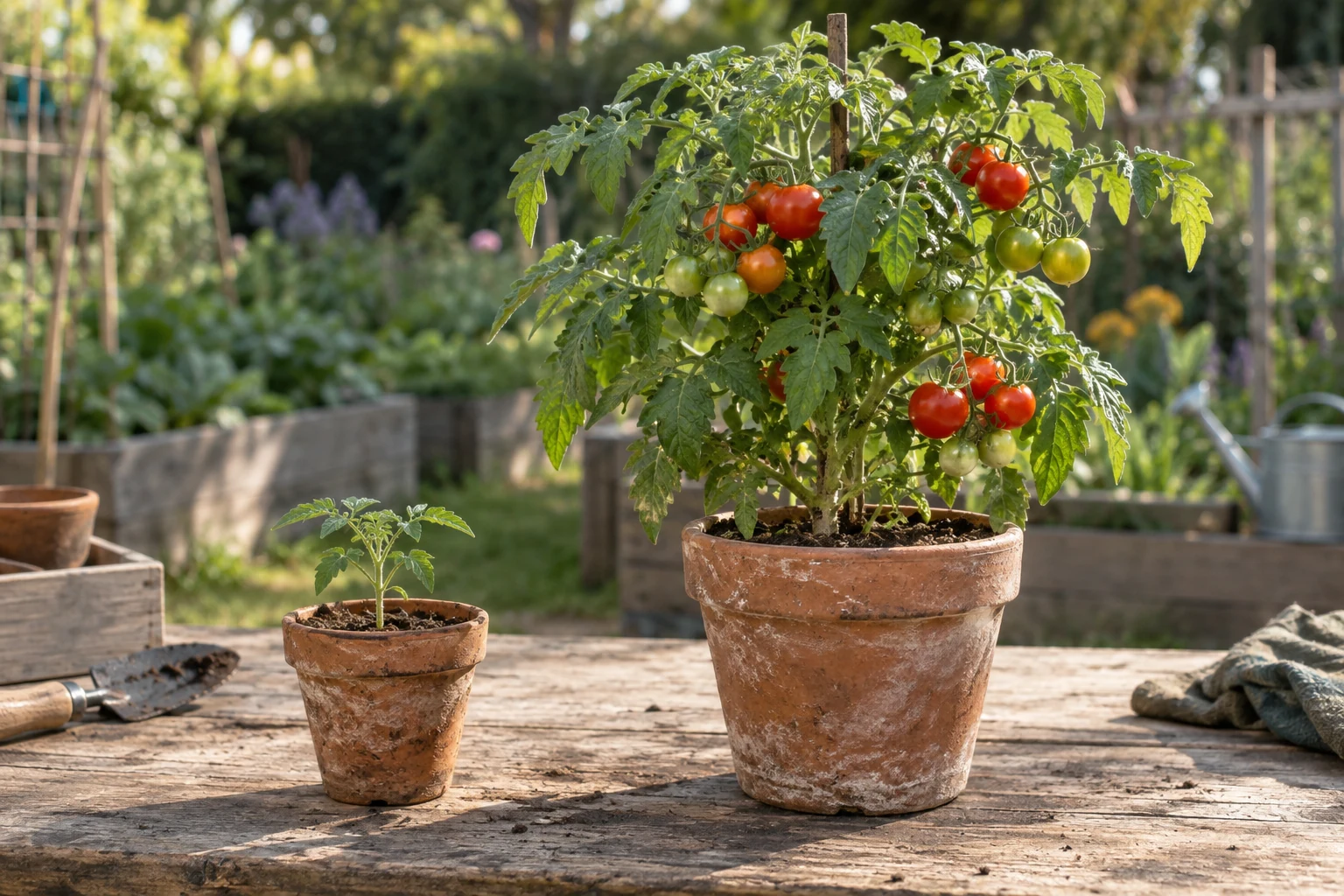
Start with the growth habit: a compact bush tomato and a climbing indeterminate tomato need different space and support. Warmth, local frost risk and consistent root-zone moisture matter more than a universal calendar date.
The tomatoes growing story
Illustrative vining tomato grown from a start. Phases overlap in a real plant; these are not equal-duration intervals.
01Plan & prepare
An empty bed is a decision, not wasted space.
Choose the crop, usable root space and planting window before sowing.
One useful observationWrite the variety and the part you want to eat.
Explore it in 3D →02Sow & germinate
The first change starts before a leaf is visible.
Germination and emergence are different events; follow seed-specific conditions.
One useful observationRecord sowing and first visible emergence separately.
Explore it in 3D →03Seedling establishment
Small leaves, a small canopy, a growing root system.
Seedlings need suitable light, moisture and room to develop.
One useful observationLook for new true leaves rather than guessing from height.
Explore it in 3D →04Harden off & transplant
From a protected start to a growing bed.
Gradual outdoor exposure precedes planting into suitable warm conditions.
One useful observationCheck local frost risk and prepare support.
Explore it in 3D →05Build leaves & stems
The trellis supports the plant; it is not part of it.
Vining tomatoes keep extending their canopy.
One useful observationNotice the difference between a main stem and a support string.
Explore it in 3D →06Flowering
Look for small yellow flowers.
Tomato fruit develops from flowers; timing depends on conditions.
One useful observationFind a flower and revisit the same place later.
Explore it in 3D →07Fruit set & enlargement
Green fruit is forming, not ready because a timer says so.
Moisture consistency matters during fruit development.
One useful observationRecord changing fruit size without estimating yield.
Explore it in 3D →08Ripen & harvest
Fruit colors are schematic maturity cues.
Pick according to the variety and usable maturity, not this animation.
One useful observationCompare a real fruit with its cultivar description.
Explore it in 3D →09Post-harvest & next crop
The bed has a history—and another possibility.
Record the harvest and consider sanitation and the next planting.
One useful observationRecord what grew here and one change for the next cycle.
Explore it in 3D →What’s worth understanding
Transplant after frost risk has passed and the soil is warm; vining types need support.
Moisture swings during fruit development can contribute to blossom-end rot. A black patch is not automatically an insect problem.
Vining tomatoes can carry flowers and ripening fruits simultaneously. A linear animation separates phases that can overlap in the garden.
Take it into your growing space
- 1
Read your seed packet: bush or vining?
- 2
Use the tunnel growth slider to find flowers, then fruit.
- 3
Record one real plant’s variety, planting date and first ripe fruit.
Do not treat the illustrative 3D growth slider as a yield or harvest-date prediction.
A starting point—not a prescription
The tools use editable example inputs for spacing and timing. Replace them with your seed packet, cultivar, system, and local Extension advice. Days to maturity are not the same as days remaining in your season.
Try this crop in the plannerFollow the connections
These are editorial learning connections, not claims that one practice scientifically causes another.